

Electrolyte Additives for Sodium-Ion Batteries Market Report: Price Forecast and Growth Drivers (2026–2036)
Rising demand for grid-scale energy storage and commercialization of sodium-ion battery production accelerates global market expansion
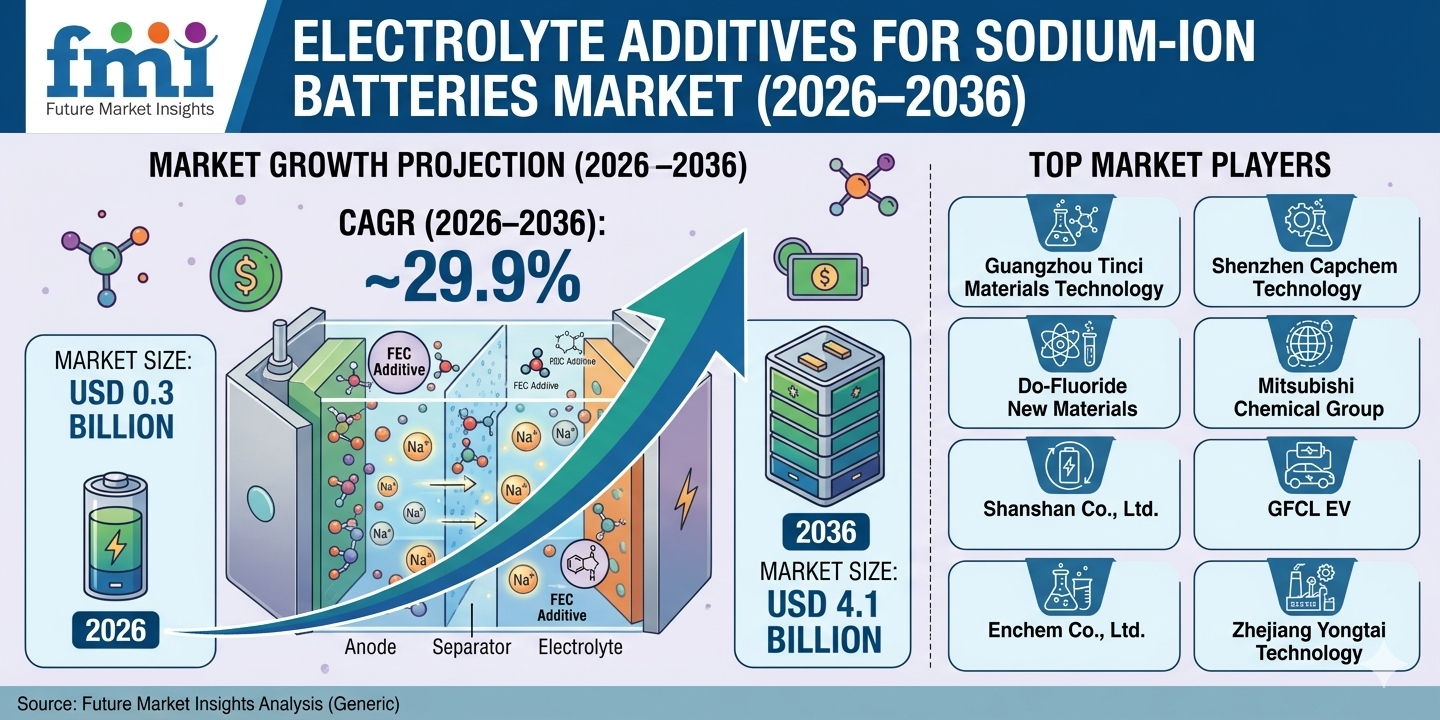
NEWARK, DE, UNITED STATES, March 16, 2026 /EINPresswire.com/ -- The global Electrolyte Additives for Sodium-Ion Batteries Market is valued at USD 0.3 billion in 2026 and is projected to reach USD 4.1 billion by 2036, expanding at a CAGR of 29.9% from 2026 to 2036. Growth is driven by the rapid commercialization of sodium-ion battery technology, expansion of gigafactory-scale production, and the increasing need for advanced electrolyte stabilization to improve battery cycle life and safety.
As sodium-ion batteries transition from laboratory research to commercial deployment, electrolyte additives are emerging as critical performance-enabling chemicals. These specialized compounds stabilize electrode interfaces, prevent capacity fade, and ensure reliable battery performance across demanding applications such as renewable energy storage and electric mobility.
Electrolyte Additives for Sodium-Ion Batteries Market Snapshot (2026–2036)
• Market size in 2026: USD 0.3 billion
• Market size in 2036: USD 4.1 billion
• CAGR (2026–2036): ~29.9%
• Leading additive type: Film-forming electrolyte additives
• Top end-use segment: Stationary energy storage systems
• Dominant electrolyte system: Non-aqueous electrolytes
• Fastest-growing country: China
• Key companies: Global specialty chemical and battery material suppliers
Market Momentum
The Electrolyte Additives for Sodium-Ion Batteries Market begins at USD 0.3 billion in 2026, supported by accelerating investments in sodium-ion battery manufacturing capacity and pilot deployments in grid-scale storage systems.
Between 2027 and 2030, the expansion of renewable energy infrastructure and gigafactory-scale battery production intensifies demand for specialized electrolyte formulations capable of stabilizing sodium-ion electrochemistry.
Entering 2032 and beyond, tighter performance requirements, improved additive chemistry, and expanded supply chains for advanced fluorinated compounds reinforce growth. By 2036, the market reaches USD 4.1 billion, maintaining strong momentum as sodium-ion batteries become an increasingly viable alternative to lithium-based storage systems.
Why the Market is Growing
The Electrolyte Additives for Sodium-Ion Batteries Market is expanding as battery manufacturers scale sodium-ion technology for commercial applications. Unlike lithium-ion systems, sodium-ion batteries require specialized electrolyte additives to stabilize the solid electrolyte interphase (SEI) on hard carbon anodes and protect cathode materials during repeated cycling.
Without these additives, sodium-ion cells experience severe capacity degradation and poor cycle life. Advanced film-forming compounds, flame-retardant additives, and solvation modifiers help suppress parasitic reactions and improve long-term battery stability.
Another key growth factor is the increasing deployment of grid-scale energy storage systems. Utilities integrating renewable energy require batteries capable of operating for thousands of cycles while maintaining thermal stability and safety. Electrolyte additives provide the chemical control necessary to achieve these performance benchmarks.
Rather than serving as minor formulation components, electrolyte additives are now considered critical engineering inputs that directly determine battery longevity, safety, and commercial viability.
Request For Sample Report | Customize Report |purchase Full Report - https://www.futuremarketinsights.com/reports/sample/rep-gb-32228
Segment Spotlight
1. End Use: Stationary Energy Storage Leads Demand
Stationary energy storage accounts for approximately 55% of end-use demand, as utilities deploy sodium-ion batteries to balance renewable energy generation and stabilize power grids. These systems require batteries capable of delivering thousands of charge cycles, driving the adoption of high-performance electrolyte additives.
2. Additive Type: Film-Forming Additives Dominate
Film-forming additives represent nearly 45% of additive demand, as they play a crucial role in building a stable protective layer on the hard carbon anode. This layer prevents electrolyte decomposition and ensures long-term capacity retention during continuous cycling.
3. Electrolyte System: Non-Aqueous Electrolytes Remain Core Platforms
Non-aqueous electrolytes account for about 68% of the market, reflecting their ability to support high-voltage operation and deliver energy density levels comparable to established lithium-ion chemistries.
Drivers, Opportunities, Trends, Challenges
Drivers
• Commercialization of sodium-ion battery gigafactories
• Rising demand for grid-scale renewable energy storage
• Increasing need for long-cycle-life battery chemistries
Opportunities
• Development of advanced fluoroethylene and organophosphorus additives
• Integration of solid-state and hybrid electrolyte architectures
• Expansion of localized battery chemical manufacturing hubs
Trends
• Rapid scaling of sodium-ion battery production capacity
• Increasing focus on electrolyte interface engineering
• Strategic supply agreements between chemical suppliers and battery manufacturers
Challenges
• Complex synthesis requirements for high-purity additives
• Limited global manufacturing capacity for specialized organofluorine compounds
• Qualification barriers in automotive and grid storage applications
Country Growth Outlook (2026–2036)
China leads global expansion with an expected 34.0% CAGR, supported by aggressive investments in sodium-ion gigafactories and renewable energy infrastructure. India follows with 31.5% CAGR, driven by domestic initiatives to reduce reliance on imported lithium resources and build independent battery supply chains.
South Korea grows at 29.0%, leveraging its strong chemical manufacturing sector and battery technology expertise. The United States expands at 28.5%, supported by grid modernization programs and growing demand for alternative battery chemistries. Germany and Japan maintain steady growth through automotive innovation and advanced chemical engineering capabilities.
Competitive Landscape
The market features specialty chemical companies and battery material suppliers competing on formulation expertise, additive purity, and large-scale production capabilities. Industry leaders are investing heavily in organofluorine chemistry, interface stabilization technologies, and high-purity additive manufacturing.
Major participants such as Guangzhou Tinci Materials Technology, Shenzhen Capchem Technology, Do-Fluoride New Materials, Mitsubishi Chemical Group, and Shanshan Co., Ltd. continue expanding their electrolyte additive portfolios to support next-generation sodium-ion battery development.
Additional suppliers including GFCL EV, Enchem Co., Ltd., and Zhejiang Yongtai Technology are strengthening their positions through upstream integration, process control improvements, and strategic partnerships with battery manufacturers.
Competition increasingly centers on additive performance validation, supply reliability, and compatibility with gigafactory-scale battery production environments.
Explore More Related Studies Published by FMI Research:
Hygroscopic Building Material Market: https://www.futuremarketinsights.com/reports/hygroscopic-building-material-market
OEM Procurement Models for Electronics-Grade PCR Materials Market: https://www.futuremarketinsights.com/reports/oem-procurement-models-for-electronics-grade-pcr-materials-market
Styrene Butadiene Latex Market: https://www.futuremarketinsights.com/reports/styrene-butadiene-latex-market
About Future Market Insights (FMI)
Future Market Insights, Inc. (FMI) is an ESOMAR-certified, ISO 9001:2015 market research and consulting organization, trusted by Fortune 500 clients and global enterprises. With operations in the U.S., UK, India, and Dubai, FMI provides data-backed insights and strategic intelligence across 30+ industries and 1200 markets worldwide.
Why FMI: https://www.futuremarketinsights.com/why-fmi
Sudip Saha
Future Market Insights Inc.
+1 347-918-3531
rahul.singh@futuremarketinsights.com
Legal Disclaimer:
EIN Presswire provides this news content "as is" without warranty of any kind. We do not accept any responsibility or liability for the accuracy, content, images, videos, licenses, completeness, legality, or reliability of the information contained in this article. If you have any complaints or copyright issues related to this article, kindly contact the author above.
