

Global Wind Blade Bio-Resin Composites Market Led by Europe as Solvay and Evonik Expand Sustainable Materials
Wind Blade Bio-Resin Composites
Wind Blade Bio-Resin Composites Market Size and Share Forecast Outlook
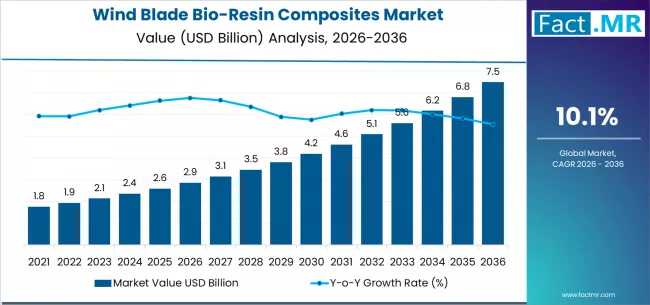
ROCKVILLE, MD, UNITED STATES, April 3, 2026 /EINPresswire.com/ -- As the wind energy sector transitions from "clean operations" to "clean manufacturing," the global Wind Blade Bio-Resin Composites Market is emerging as the silent engine of industrial decarbonization. New data reveals the market is poised to leap from USD 2.86 billion in 2026 to a staggering USD 7.49 billion by 2036, cruising at a 10.1% CAGR.This shift represents more than a material swap; it is a strategic response to the industry’s biggest "green paradox"—the end-of-life challenge of massive turbine blades. Decision-makers are increasingly pivoting toward bio-based thermosets not just for their lower carbon footprint, but for their potential to unlock true blade recyclability.
Get Access Report Sample :
https://www.factmr.com/connectus/sample?flag=S&rep_id=13255
Executive Summary: Market at a Glance
Metric
Details & Data Points
Market Value (2026)
USD 2.86 Billion
Projected Value (2036)
USD 7.49 Billion
Growth Velocity
10.1% CAGR
Dominant Resin Type
Bio-Epoxy (37% Share)
Primary Application
Onshore Wind (56% Share)
Growth Leaders
USA (11.2%), China (10.8%), Germany (9.6%)
The "Drop-In" Solution: Why Bio-Epoxy Leads
Bio-epoxy resins currently command 37% of the market. Their success lies in performance parity. Derived from plant oils and waste glycerin, these resins offer a direct "drop-in" replacement for fossil-based epoxies. For manufacturers, this means achieving net-zero targets without re-engineering the structural spar caps or shear webs that keep blades spinning for 25+ years.
Onshore Scaling & The Glass Fiber Backbone
While offshore wind captures headlines, Onshore Wind Turbines (56% share) remain the high-volume testing ground for bio-composites. Combined with Glass Fiber Reinforcement (45%), bio-resins are proving they can meet aggressive cost targets and production schedules.
Strategic Regional Shifts
USA (11.2% CAGR): Policy is the primary propellant. The Inflation Reduction Act (IRA) is incentivizing domestic supply chains, pushing localized bio-resin production to the forefront.
China (10.8% CAGR): As the world’s manufacturing hub, China is leveraging its scale to drive down the cost of bio-based precursors like epichlorohydrin.
Europe (Germany/Denmark): Leadership here is defined by engineering. These nations are treating bio-composites as a "living laboratory," focusing on durability in harsh marine environments.
Strategic Insights for Decision Makers
The transition to bio-resins is no longer a "nice-to-have" CSR initiative. With carbon border adjustments and stricter green procurement criteria, low-embodied-carbon blades are becoming a competitive necessity. Success for OEMs now depends on:
Supply Chain Security: Securing non-food-competing feedstock.
Certification Readiness: Navigating the complex validation for 20+ year fatigue resistance.
Digital Integration: Utilizing AI and digital twins to optimize curing cycles for new bio-chemistries.
Browse Full Report –
https://www.factmr.com/report/wind-blade-bio-resin-composites-market
To View Related Report:
Wind Turbine Material Industry Analysis in the USA https://www.factmr.com/report/united-states-wind-turbine-material-industry-analysis
Wind Turbine Material Industry Analysis in the United Kingdom https://www.factmr.com/report/united-kingdom-wind-turbine-material-industry-analysis
Wind Turbine Material Market https://www.factmr.com/report/4605/wind-turbine-materials-market
Windproof Fabrics Market https://www.factmr.com/report/windproof-fabrics-market
S. N. Jha
Fact.MR
+1 628-251-1583
email us here
Legal Disclaimer:
EIN Presswire provides this news content "as is" without warranty of any kind. We do not accept any responsibility or liability for the accuracy, content, images, videos, licenses, completeness, legality, or reliability of the information contained in this article. If you have any complaints or copyright issues related to this article, kindly contact the author above.
