

Ali Dasdan on the CAIO Connect Podcast: Lessons from a CTO on AI, Quality, and Leadership

CAIO Connect Podcast
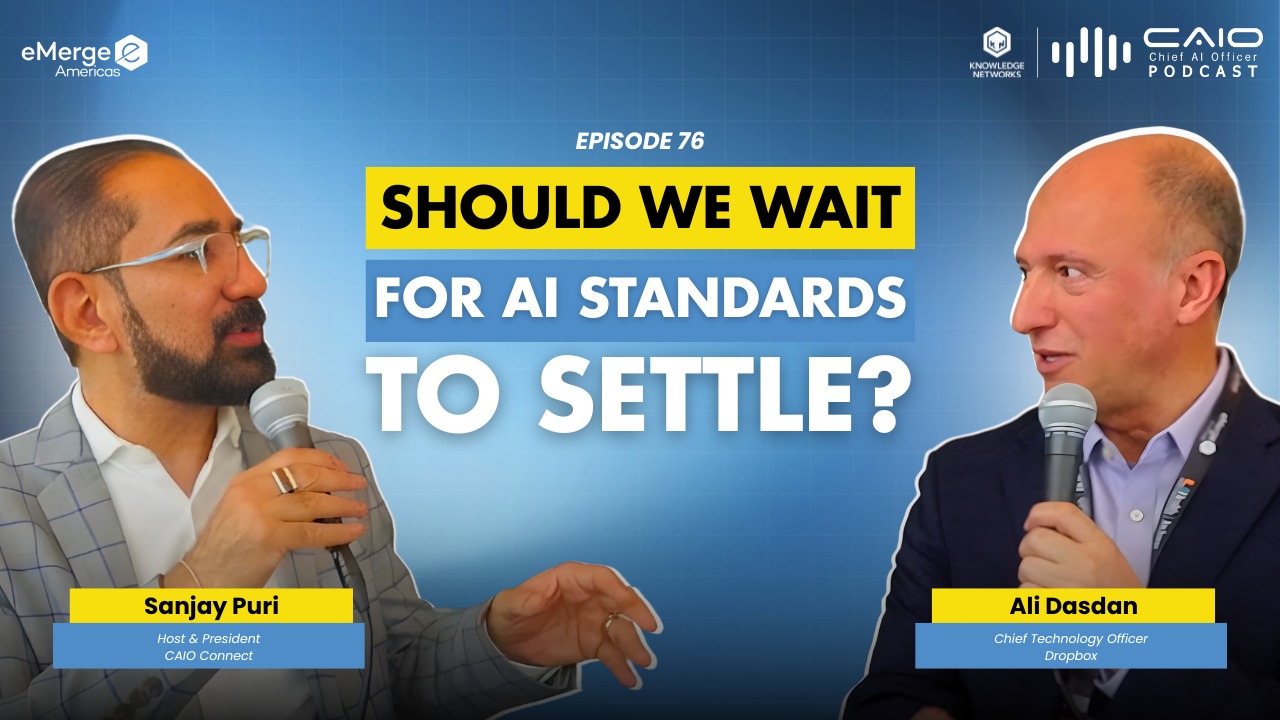
Ali Dasdan, CTO of Dropbox, with Sanjay Puri, President of CAIO Connect
On the CAIO Connect Podcast, Ali Dasdan shares how CTOs can use AI, focus on quality, prove ROI, and lead innovation with hands-on experience and trust.
Ali opens by describing his unconventional career path. He has worked across industries like chip design, web search, e-commerce, digital health, and payments. This broad exposure helped him develop a deep understanding of systems, scale, and product thinking. He explains that working in chip design at companies like Synopsys taught him how to handle complex, stochastic systems where accuracy and speed matter. These lessons now apply directly to modern AI systems, especially large language models. A key theme in the discussion is that many techniques used in today’s AI systems are not entirely new. Ali points out that chip design already relied on multi-parameter optimization, approximation, and fast computation. These same ideas now power LLMs. His experience allowed him to recognize patterns early and adapt quickly to the rise of generative AI.
When the host asks about choosing AI models, Ali keeps his answer simple: focus on quality first. He explains that while factors like token size or context window matter, they should not outweigh output quality. His teams often use multiple models at once, switching between them based on performance. In fact, he notes that many developers now rely on more than one model simultaneously. To simplify this, his organization builds internal systems that automatically select the best model for a given task. The conversation then shifts to ROI, a major concern for AI leaders. Ali acknowledges that measuring impact has always been difficult, even before AI. Writing code does not directly translate to business value, and AI only amplifies this challenge. He advises leaders to look beyond simple productivity metrics. While his team doubled developer productivity, he emphasizes that quality and business impact matter more.
Ali suggests that organizations should track how much more they can deliver with the same team size. For example, developers can now handle additional work like reducing technical debt or completing extra projects. By making this progress visible and aligning it with business goals, leaders can better communicate ROI to boards and CFOs. Another strong point Ali makes is about leadership responsibility. He believes CTOs must stay hands-on with technology, especially AI tools. Without direct experience, leaders cannot guide their teams effectively. He argues that real expertise comes from building, failing, and learning—not just managing from a distance.
The role of the CTO, according to Ali, has expanded significantly. AI has increased expectations across the entire organization. CTOs no longer support just engineering teams; they now enable functions like HR, finance, and operations. This shift requires broader thinking and faster decision-making. At the same time, scrutiny has increased, making the role more demanding than ever. Security and trust also take center stage in the discussion. Ali stresses that customer trust must remain the top priority. He explains that strong encryption, access control, and clear data governance are essential. More importantly, leaders must consistently communicate that security comes first. This alignment ensures that teams prioritize it in every decision.
When discussing AI agents, Ali highlights the importance of building the right foundation. He explains that successful implementation requires strong context layers, orchestration systems, and secure data handling. Simply deploying an agent is not enough. Organizations must invest in the underlying platform to ensure reliability and scalability.
Finally, Ali offers a clear message to leaders: do not wait. The AI landscape evolves rapidly, and delaying adoption can put organizations at a disadvantage. While standards may change, core systems like context management and security will remain critical. His closing advice is simple and direct—start now.
This episode of the CAIO Connect Podcast delivers a grounded, experience-driven view of AI leadership. Through Ali’s insights, listeners learn that success in AI depends not just on technology but on quality, execution, and a willingness to adapt quickly.
Upasana Das
Knowledge Networks
email us here
Visit us on social media:
LinkedIn
Instagram
Facebook
YouTube
X
Legal Disclaimer:
EIN Presswire provides this news content "as is" without warranty of any kind. We do not accept any responsibility or liability for the accuracy, content, images, videos, licenses, completeness, legality, or reliability of the information contained in this article. If you have any complaints or copyright issues related to this article, kindly contact the author above.
