

Sacramento Homeowners Face 30% Insurance Hikes as Vegetation Rules Trigger Non-Renewals

The primary brand logo for Golden Roots Tree Care, displayed on a dark green background with gold and white text.
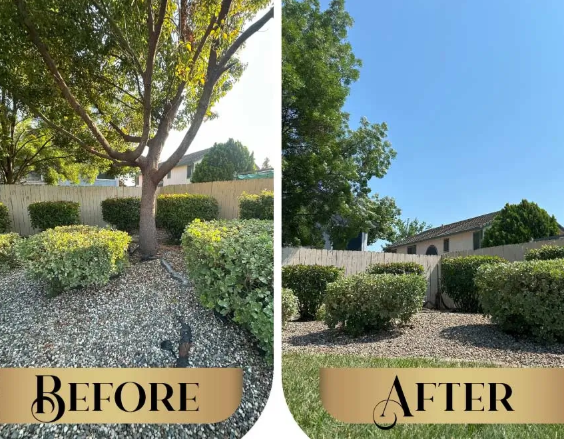
A side-by-side comparison showing a tree before and after professional clearance to meet defensible space standards.
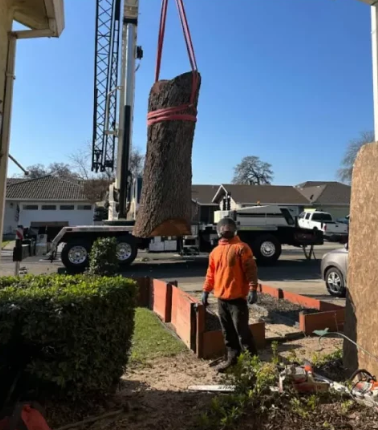
A professional arborist conducting a technical tree removal using heavy equipment in a residential setting.
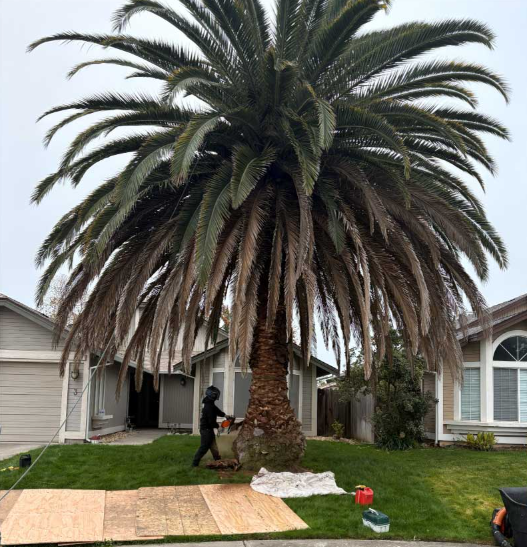
An arborist performing precise pruning on a mature palm tree to maintain health and safety.

An arborist using professional tools to safely conduct a tree removal near a residential property.
Sacramento homeowners face 30% insurance hikes due to vegetation-based non-renewals. Ensure compliance with ISA-certified tree care mitigation.
SACRAMENTO, CA, UNITED STATES, June 23, 2026 /EINPresswire.com/ -- The California homeowners insurance market, already strained by years of catastrophic wildfires and regulatory shifts, has entered a new phase of contraction that is now directly impacting the suburban landscapes of the Greater Sacramento area. Market analysts and insurance industry watchdogs report a significant surge in "vegetation-based non-renewals," a trend where carriers utilize high-resolution aerial surveillance to identify overhanging branches and insufficient "defensible space" as primary grounds for terminating coverage. For residents in Sacramento, Elk Grove, and Wilton, the failure to align residential landscapes with evolving actuarial standards now carries a specific financial penalty: the immediate threat of being forced into the California FAIR Plan, which frequently results in premium hikes of 30% or more.
The Eye in the Sky: Aerial Surveillance and Actuarial Shift
The shift in how insurance companies evaluate property risk has been accelerated by advancements in geospatial technology. Major carriers are no longer relying solely on physical, boots-on-the-ground inspections to assess a property's risk profile. Instead, they are employing sophisticated satellite imagery and drone-based surveillance to monitor the proximity of tree canopies to rooflines and the density of vegetation within the critical 100-foot defensible space zone.
According to recent insurance industry reports, this "eye in the sky" approach allows carriers to process thousands of properties simultaneously, flagging "non-compliant vegetation" with algorithmic precision. For the Sacramento homeowner, this means that a single mature oak branch overhanging a garage or a cluster of unpruned palms can trigger an automated non-renewal notice months before a policy's expiration date. The conflict arises as the region's celebrated urban forest—the very feature that defines the "City of Trees"—is increasingly viewed by underwriters as a multi-million dollar fire and liability hazard.
The Economic Fallout of the FAIR Plan Transition
When a private carrier issues a non-renewal notice based on vegetation risks, homeowners are often left with a narrow window to perform mitigation or face a total policy lapse. In the current market, the primary safety net is the California FAIR Plan, the state’s "insurer of last resort." While the FAIR Plan provides essential coverage, it is notoriously more expensive and offers less comprehensive protection than traditional policies.
Financial data suggests that the transition from a preferred private policy to a FAIR Plan policy, combined with the necessary supplemental "Difference in Conditions" (DIC) coverage, results in an average premium increase of 30% to 50% for Sacramento-area properties. For a standard residential property, this can equate to thousands of dollars in additional annual expenditure. Consequently, professional brush clearance and structural tree maintenance have shifted from being considered "aesthetic landscaping" to becoming "critical financial infrastructure".
Localization: The Sacramento Defensible Space Standard
While "defensible space" was once a term reserved for the wildfire-prone foothills of the Sierra Nevada, it has become a standard requirement for suburban neighborhoods in the Sacramento Valley, including Vineyard, Florin, and Sheldon. Insurers are now strictly adhering to—and often exceeding—CAL FIRE’s Public Resources Code 4291, which requires 100 feet of defensible space around all structures.
In the Sacramento context, this involves two distinct zones:
Zone 1 (0-30 feet): Often called the "Lean, Clean, and Green" zone, requiring the removal of all dead vegetation and the thinning of canopies to prevent heat transfer to the home.
Zone 2 (30-100 feet): Focused on "reduced fuel," where trees must be pruned to ensure a vertical clearance of at least 6 feet from the ground and horizontal spacing between canopies to prevent "crown-to-crown" fire spread.
For property owners in high-density residential areas, achieving these standards requires technical expertise, particularly when dealing with mature heritage trees that require specialized pruning to maintain health while meeting compliance.
Expert Analysis: The ISA Certified Perspective
As the crisis deepens, the role of the arborist has evolved from a caretaker of tree health to a consultant on property liability. Lorenzo Sanchez Perez, an ISA Certified Arborist (Certification WE-15860A) and founder of Golden Roots Tree Care, has observed a fundamental shift in client motivation over the past 24 months.
"The demand for 'insurance-mandated clearances' has shifted from a safety suggestion to a financial necessity for local residents," states Sanchez Perez. "We are increasingly being called out not because a homeowner wants a better view, but because they have received a letter from their carrier demanding the removal of specific 'fuel loads' or overhanging limbs within 30 days".
Sanchez Perez notes that many homeowners are surprised to find that the cost of professional mitigation is a fraction of the long-term financial consequences of a policy non-renewal. "Property owners are discovering that the cost of professional brush clearance is a fraction of the premium spike associated with a policy lapse," he explains. "By the time a homeowner is forced into the FAIR Plan, they have already lost the opportunity to save that money through proactive maintenance".
Furthermore, the quality of the work is under as much scrutiny as the clearance itself. Carriers are looking for sustainable "crown restoration" and "crown thinning" rather than "tree topping," which can actually increase fire risk by creating a flush of weak, highly flammable "water sprouts".
"Honesty and education are critical here," adds Sanchez Perez. "It’s about explaining to the client what must be done to satisfy the insurer while ensuring the tree has the structural integrity to survive the next Sacramento north wind event or atmospheric river".
Proactive Mitigation vs. Reactive Removal
The trend toward vegetation-based non-renewals highlights a growing "cost gap" in property management. Market analysis suggests that property owners who engage in proactive structural maintenance and regular fire season prep spend significantly less over a five-year period than those who are forced into reactive, emergency removals following an insurance ultimatum.
In Sacramento, where the urban canopy is a major contributor to property value, the goal for many is to find a balance between compliance and preservation. Certified professionals utilize techniques like Technical Removals for hazardous trees and Health Assessments to identify which assets can be saved through compliant pruning.
About Golden Roots Tree Care
Located in Sacramento, California, Golden Roots Tree Care is a premier provider of comprehensive tree management solutions for residential and commercial properties. Founded in 2021 by ISA Certified Arborist Lorenzo Sanchez Perez, the company specializes in tree health assessments, disease treatment, technical removals, and aesthetic pruning. Golden Roots Tree Care is committed to the values of honesty, responsibility, and sustainable arboriculture, serving the communities of Sacramento, Elk Grove, Wilton, Vineyard, Florin, and Sheldon.
Luis Chavez
Chavez Web Design, LLC
+1 559-553-5000
email us here
Visit us on social media:
Instagram
Facebook
YouTube
TikTok
Other
Golden Roots Tree Care: Expert Tree Removal Time-Lapse
Legal Disclaimer:
EIN Presswire provides this news content "as is" without warranty of any kind. We do not accept any responsibility or liability for the accuracy, content, images, videos, licenses, completeness, legality, or reliability of the information contained in this article. If you have any complaints or copyright issues related to this article, kindly contact the author above.
